
When people think of China, they very often think of Guilin, unwittingly or otherwise. The city’s surrounding landscape has inspired countless poems and paintings, with its sharply pointed karst mountains pushing skyward on either side of a gentle meandering river, stretching out unendingly over the horizon, often shrouded in a mysterious mist, creating a living, breathing work of art.
Located in Guangxi Zhuang Autonomous Region, it’s one of China’s most spectacular natural scenes, so revered by the locals that any mention of it will elicit from them the response “桂林山水甲天下” – or in English, “the scenery in Guilin is the greatest under heaven”, words first carved into one of the city’s many towering peaks by poet Wang Zhenggong back in 1201. More than 800 years later, it’s a hypothesis that’s still hard to argue against.
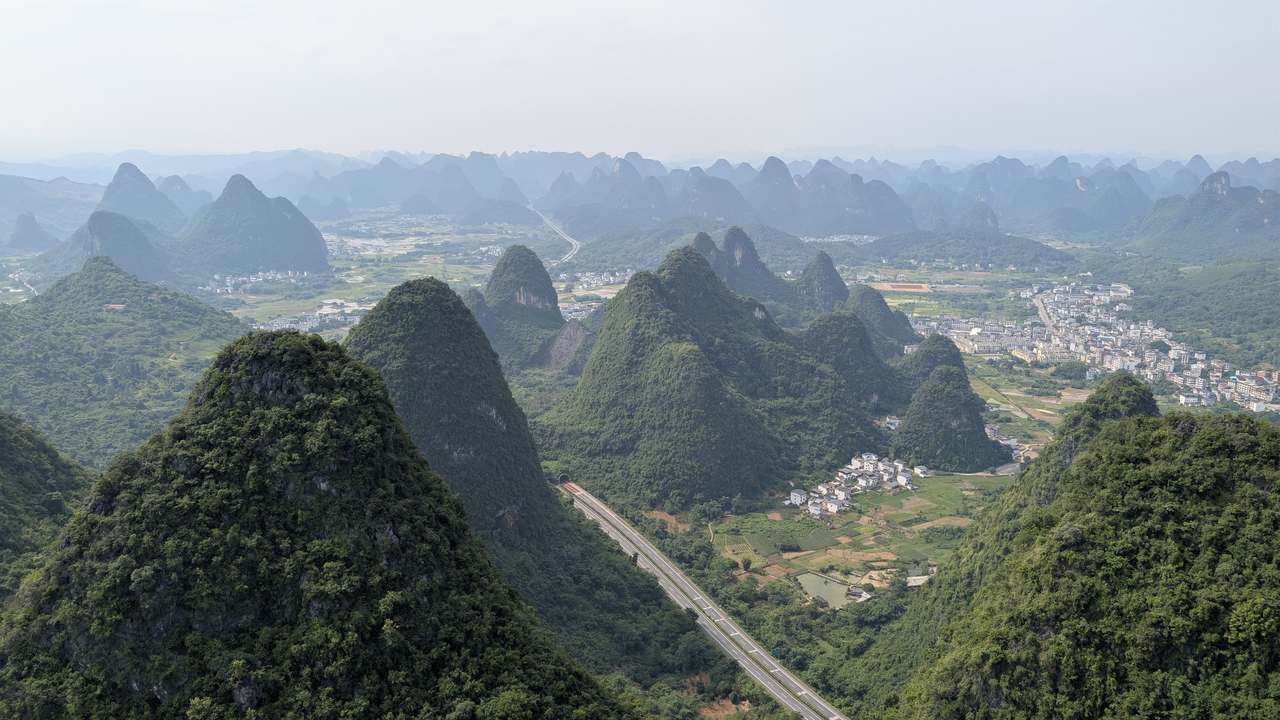 The chances are you’ve at least seen a photo of Guilin, as it’s often used as something of a poster child for China, yet to be immersed in its backdrops, to float gently along the Li River beside the fishermen on bamboo rafts, the agile swooping cormorants and the striding water buffalo, surrounded by this slice of East Asian majesty, is an experience that cannot be replicated via the lens of a camera. It truly is one of the greatest examples of a place that must be seen to be believed.
However, due to its position in the southwestern province of Guangxi, one of two Chinese provinces that border Vietnam, providing a gateway to Southeast Asia, it’s often neglected by foreign tourists, particularly those making fleeting visits to the country.
The bustle of Beijing, or the scurrying streets of Shanghai, are given priority, simply because of their convenience and their greater notoriety, but neither the capital’s lantern-lined hutongs nor the bright lights of The Bund can hold a candle to Guilin when it comes to a natural representation of China, while similar city-centre experiences to those found in more famous locations are still easy to come by.
 That’s not to say you’re going to find an equivalent of Beijing’s Temple of Heaven or an array of nightlife to rival Shanghai’s, but Guilin’s unmistakable backdrops surround a city home to four million people, so authentic Chinese culture and modern city living are still there in abundance.
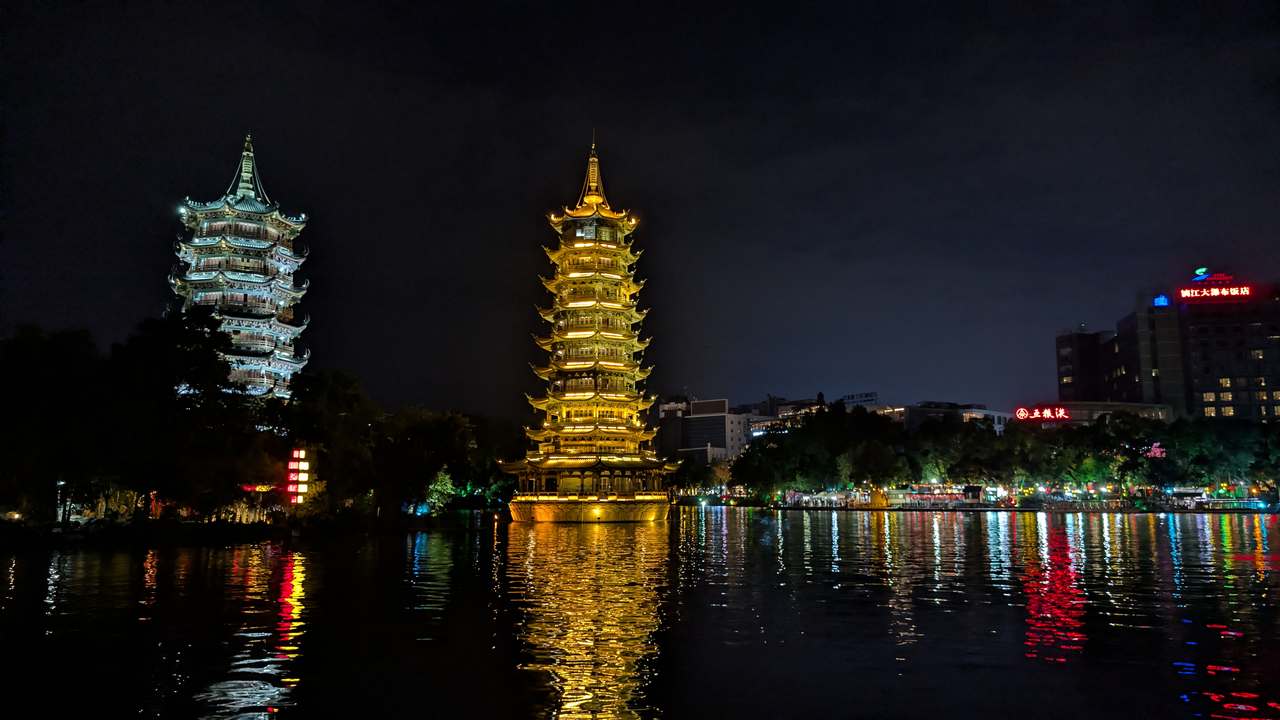
The epicentre of this is the Riyue Shuangta Park, named after the sun and moon twin pagodas that stand tall in the centre of the lake around which the park has been created. By night, they are lit up, one gold, the other silver, reflecting their celestially relevant names and providing the perfect backdrop for groups of retirees meeting up to dance with one another to traditional Chinese folk music, or for tourists to gaze upon while enjoying a beer in one of the various bars dotted around the lake’s perimeter.
It’s also the perfect spot to walk off some of the food from the nearby Xicheng Road night market, a long stretch of restaurants serving Guilin staples like mifen, an endlessly customisable noodle dish, featuring a bowl of plain rice noodles that diners are then able to coat in an array of spices, pickles, vegetables, meats and broths, according to their own preference.
Locals tend to stick to a tried and tested combination of a lot of spicy pickled vegetables, slices of beef, a meaty gravy and a boiled egg, but they won’t begrudge you a wildly different variation. The noodles soak up the flavour like little spongey strands and are the perfect vessel to get the savoury, sour and spicy flavours from bowl to mouth.
Guilin’s other most famous dish is pijiu yu, or beer fish, which features a wonderfully rich and tangy sauce made from tomatoes, spices, soy sauce and, as its name suggests, a load of beer. This is served over a river carp, fried to give it a wonderfully crispy skin, and served in the centre of the table with bowls of rice, making it an excellent communal dish to share with a group of friends, along with a few beers.
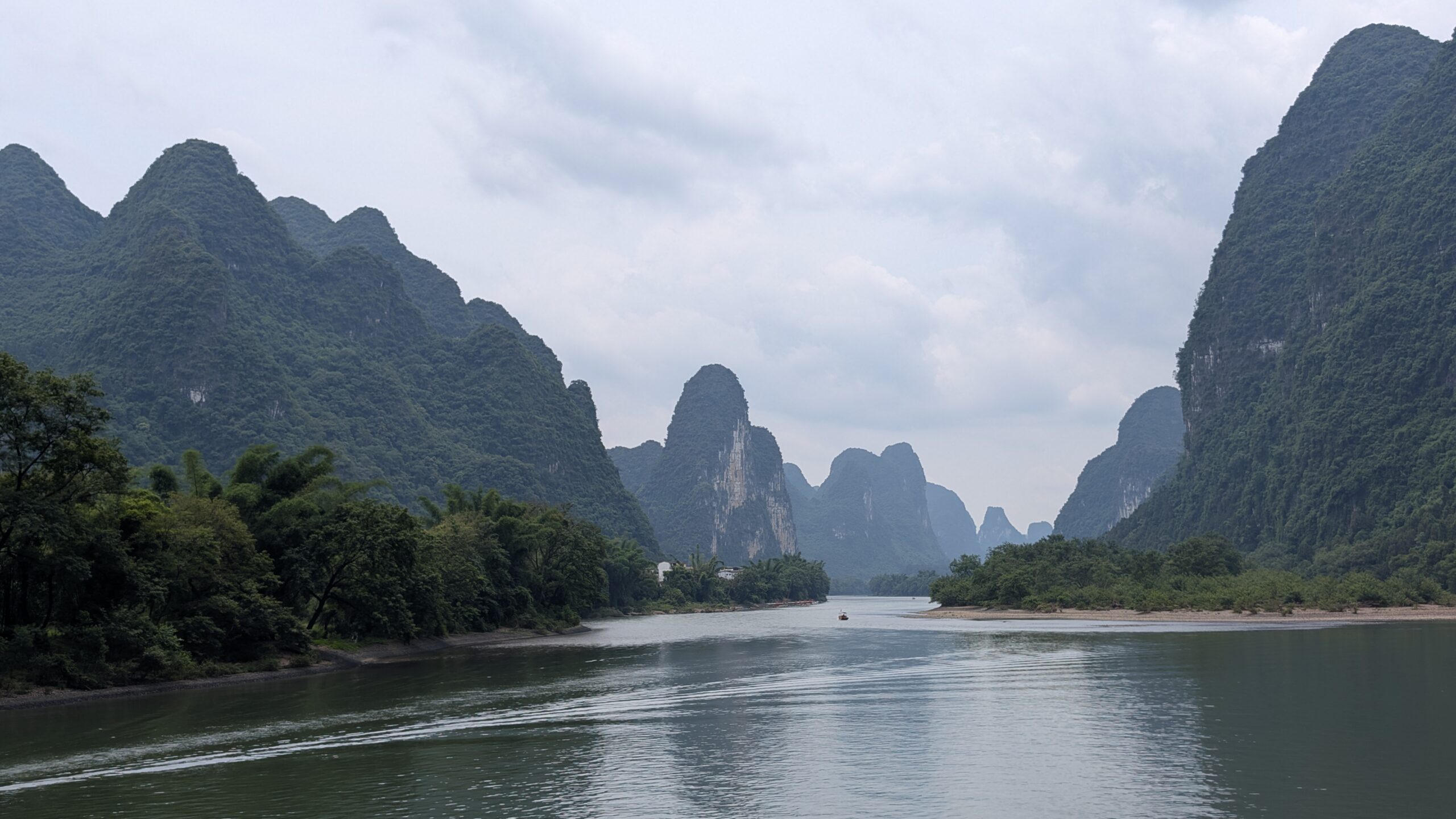
Catching carp is far from the best use of the nearby Li River, however, as taking a boat ride along it to Yangshuo is, perhaps, one of the most extraordinary experiences in the whole of China. On boarding the vessel, the captain warns that of the four-hour journey, the scenery in the first hour isn’t even worth looking at out the window when compared to the rest of the cruise.
It’s hard to believe, as the surroundings at that point are already glorious, as the Li twists its way to its destination. But by hour three, the karsts rise more theatrically, the birds seem to sing with greater euphoria, and the atmosphere becomes even more serene as those on board sail along in a nature-inspired reverie until the boat eventually docks.
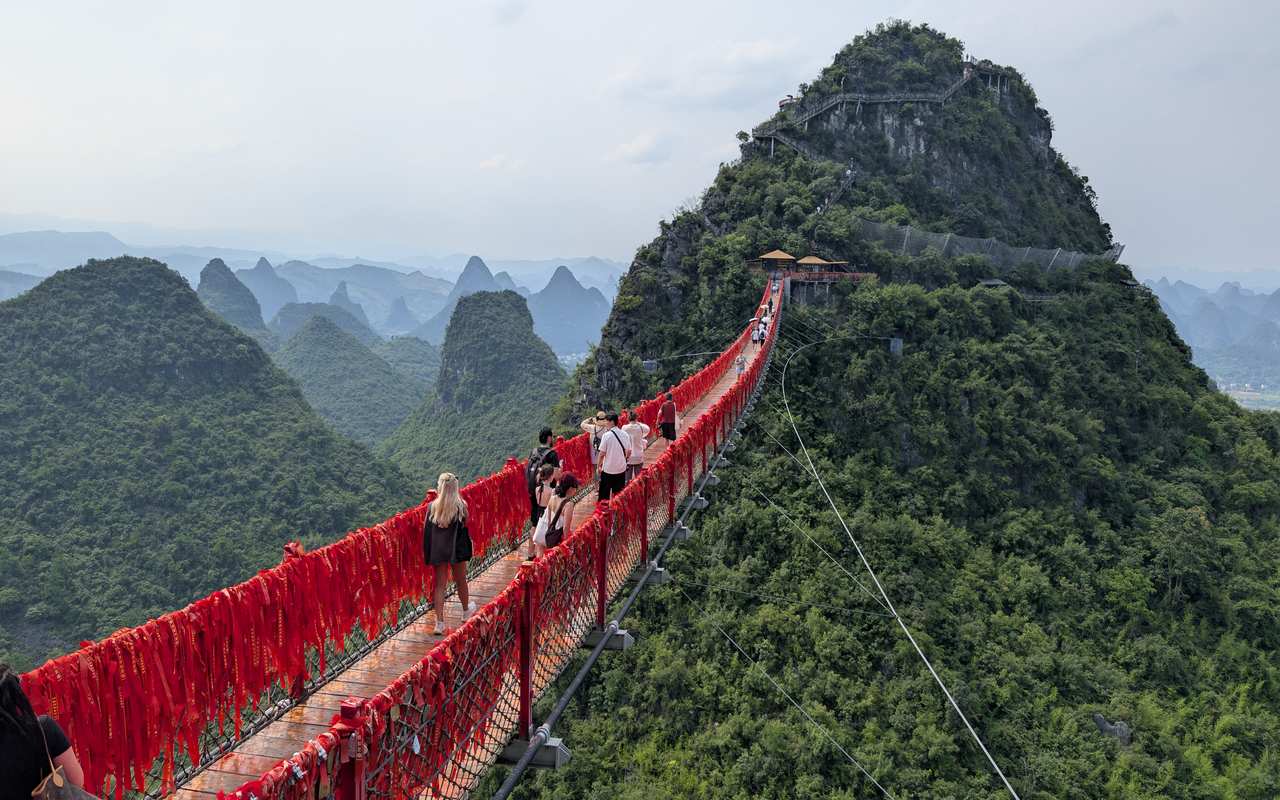 Once on terra firma, Yangshuo presents many more opportunities to become a part of its illustrious surroundings, including from above. The Ruyi Peak cable car allows visitors to ascend to the very top of some of its most astounding mountaintops, where they can weave between them using walkways and a vertigo-inspiring red footbridge. This extends out between two of the mountains and sways terrifyingly in the slightest of breezes. However, from on top, the endless sea of green conical peaks pushing towards the heavens is a view worth overcoming any phobia to behold.
Guilin’s location in the South West used to be a deterrent for travellers, especially those not wanting to navigate China’s rail system without any command of Mandarin.
Fortunately, over the last decade, technological advances, specifically the Trip app, have made buying tickets in English much simpler, making it more straightforward than ever to explore beyond the main cities, without the need to fly internally, although that is still also an option. This means that there is little reason for anyone to pick the bigger, yet less impressive destinations over this gleaming example of what China has to offer when you stray just a little bit beyond the well-worn trails.